
Can You Sharpen Serrated Knives with a Rolling Sharpener? An Honest Guide
You’ve experienced the difference a perfectly sharp chef’s knife can make in your kitchen, thanks to your rolling sharpener. But as you look at your knife block, a question comes to mind: "What about my bread knife? Can I sharpen its jagged edge, too?"
It’s a great question, and the honest answer is important for the health of your knives. As a brand dedicated to the craft of cooking, we believe in giving you the right advice, not just trying to make a sale.
So, let's talk about the unique challenge of serrated knives.
Why Serrated Knives Are Different
First, it helps to understand what makes a serrated knife work. Unlike a straight-edged knife that uses a single, continuous blade to slice, a serrated knife works like a small, sharp saw.
The "Gullets": These are the curved grooves or scallops in the blade.
The "Teeth": These are the sharp points between the gullets.
This design is brilliant for foods with a hard exterior and a soft interior, like a crusty loaf of sourdough. The teeth catch the surface and the gullets slice through the soft inside without squashing it.
Why a Rolling Sharpener Isn't the Right Tool (for This Job)
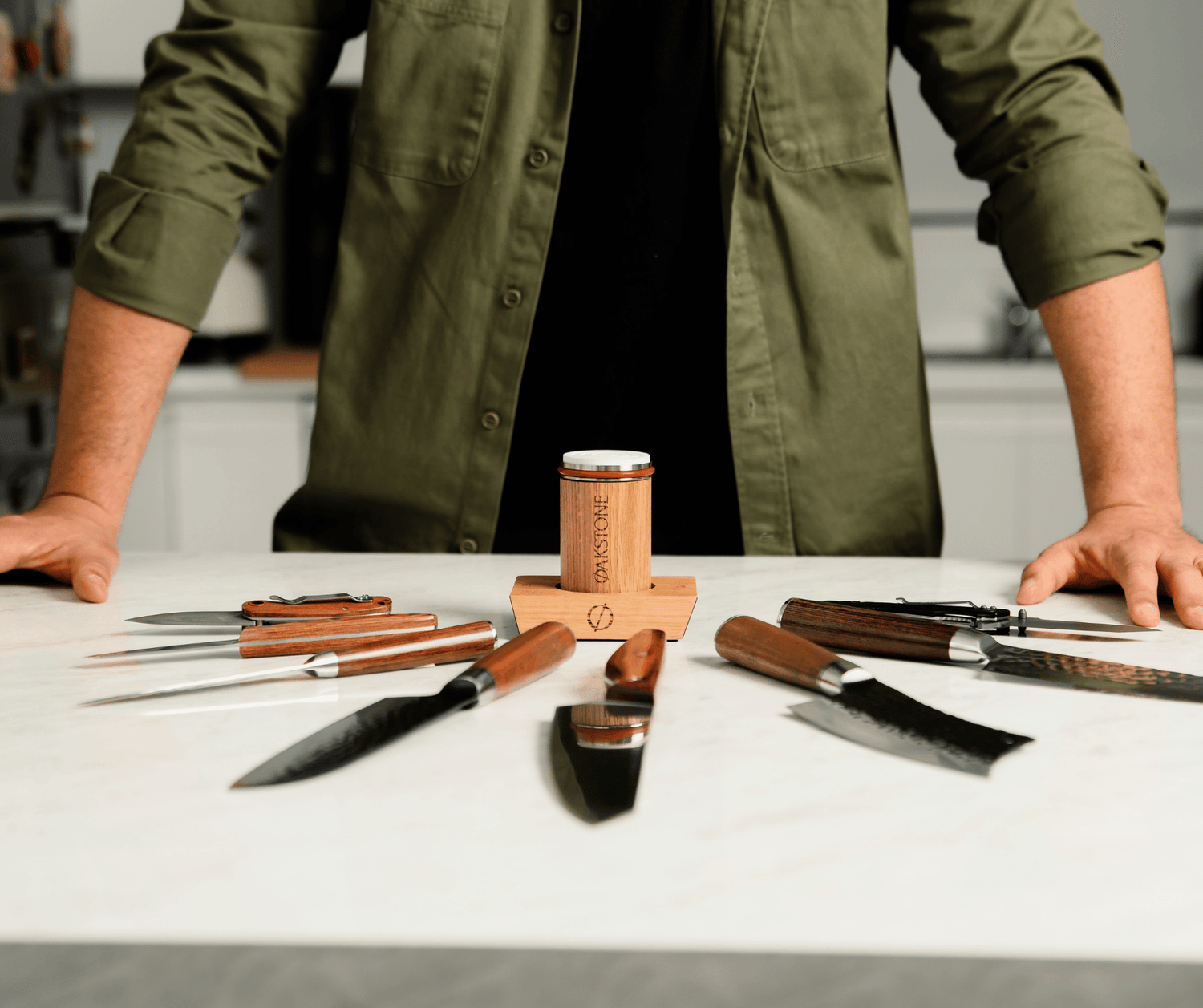
A rolling sharpener, like the Oakstone, is engineered to create a perfect, v-shaped, straight edge. Its abrasive discs are flat and designed to make consistent contact along a straight blade.
If you were to use a rolling sharpener on a serrated knife, it would grind down the sharp "teeth," effectively flattening the serrations. This would destroy the knife's sawing action and ruin its ability to cut through crusty breads or delicate-skinned fruits.
So, How Do You Sharpen a Serrated Knife?
Sharpening a serrated knife is possible, but it requires a different tool and technique. The right tool is a sharpening rod (often tapered) that has a diameter small enough to fit inside the gullets.
Find the Bevelled Side: Most serrated knives are only sharpened on one side. Identify this side (it will look angled).
Match the Angle: Place the sharpening rod into the first gullet, matching the angle of the original grind.
Sharpen Each Gullet: With a few gentle forward strokes, sharpen the inside of the gullet. Repeat this for every single one.
Remove the Burr: Once you're done, turn the knife over. You’ll find a small burr has formed. Gently file this off with one long, light stroke of your sharpening rod across the entire flat side of the blade.
For Everything Else, There's Oakstone
While a dedicated rod is best for your bread knife, remember what your Oakstone sharpener masters. For the 90% of knives in your block - your workhorse chef's knife, your nimble paring knife, your precise carving knife - our system is designed to give you that flawless, lasting edge with an ease and precision you can count on every day.
Yes. It will flatten the pointed teeth of the serrations, and once that metal is gone, it can't be restored. We strongly advise against it.
Much less often than straight-edged knives. Because the pointed teeth do the initial work and the scalloped edges are protected from hitting the cutting board, a serrated knife can hold its cutting ability for years with normal home use.
Often, no. If the knife was inexpensive, it's sometimes more practical to replace it. For a high-quality serrated knife, however, a proper sharpening can significantly extend its life.
While the ceramic abrasive is excellent for honing, the disc's shape is too large to fit into individual serrations. Using a purpose-built, tapered sharpening rod is the only way to get a good result without damaging the blade.
Did you like this article? Spread the word!


Ready to Earn Your Edge?
Get Sharpening Secrets & Members-Only Perks
The insights you need to make smarter kitchen decisions.
Ready to Earn Your Edge?
Get Sharpening Secrets & Members-Only Perks
Chef-Grade Tools
For intentional Home Cooks
Designed in Adelaide, South Australia


